Maths at Coppice Farm
Maths lead at Coppice Farm: Miss Ife
Page updated: 31/07/2026
Intent
We intend for our Maths curriculum to build secure, long‑term learning through carefully sequenced knowledge and skills.
Our maths curriculum follows clear progression to ensure concepts are introduced in small, connected steps that build strength and depth over time. From a carefully-planned curriculum in Early Years through to the end of Year 6, all children at Coppice Farm Primary School are taught skills which build on each other, allowing learning to develop within and across year groups. Children revisit and apply prior learning daily in lessons so that knowledge becomes secure and long‑lasting. Through clear sequencing, structured models and representations and opportunities to reason and problem‑solve, pupils develop resilience and confidence as mathematicians who can make meaningful links across the curriculum.
We intend for our Maths curriculum to develop independent, motivated learners.
We aim to nurture learners who show motivation, curiosity and creativity in their mathematical thinking. Children are encouraged to explore and question through anchor tasks. They choose strategies independently, developing a positive attitude towards challenge. Our approach supports pupils in becoming reflective thinkers who persevere when faced with difficulty and take pride in their growing mathematical strength which they can use throughout their lives.
We intend for our Maths curriculum to foster unity, cultural awareness and respect for diversity.
Mathematics is presented as a universal language that connects people across cultures, fostering unity and shared understanding. Through collaborative learning, children develop respect for one another’s perspectives and recognise the value of diverse approaches to problem‑solving.
We intend for our Maths curriculum to be inclusive and ensure all children can access and excel.
Our curriculum is designed so every child can succeed, with high expectations for all. Adaptive teaching, concrete resources and scaffolded support ensure that every learner can access key concepts, while opportunities for depth allow all pupils to excel. We promote positivity and resilience, ensuring children feel valued, capable and empowered to achieve their full potential in mathematics.
Implementation
Mathematics is typically taught in stand-alone lessons, with the application of mathematical skills in other areas of the curriculum.
At Coppice Farm Primary School, we believe that our children need to be taught these specific mathematical concepts to embed their learning – this then allows them to apply their mathematical skills in different contexts.
We know that our children require life skills, so through real-life contexts (such as money, shape and time), we develop these and enable all children to succeed.
Reasoning and problem solving activities are in every lesson – through the use of our anchor tasks and independent tasks – which enable all learners to discuss, justify and articulate their understanding.
From EYFS through to Year 6, our classrooms are enriched with mathematical vocabulary including STEM sentences to support our children in discussing their mathematical learning, using this in their mathematical explanations.
Each lesson is planned with opportunities in mind for promoting reading, oracy and using appropriate mathematical vocabulary. Utilising the high-quality lessons from the White Rose scheme, adults at Coppice Farm Primary School always model this vocabulary and encourage children to use age-appropriate terminology.
In lessons, high-quality questioning is utilised as an assessment tool, with adults quickly addressing misconceptions and moving learning on. High-quality resources (from the White Rose Maths scheme) are used ably by our teachers to provide challenge for all of our children. Scaffolds are displayed and made for children who may need them – including SEND children – with adult support providing additional help for our learners to ensure that every child makes progress from their starting points.
Alongside daily formative assessment, summative assessments are used three times a year (more for Y2 & 6) through Rising Stars tests or SATs past papers. Diagnostic analyses of tests take place by all teachers to highlight gaps in children’s learning, with interventions and subsequent lessons adapted suitably. Where children may need additional support with recalling these, interventions are utilised to embed mathematical fluency.
Our 10 in 10/5 in 5 and times table weekly challenge for LKS2 take place to embed learning, particularly with times tables learning and arithmetic skills.
For Mathematics CPD, the Maths subject leader is used to support colleagues, working closely with one another to share and develop good practice.
Impact
As a result of a high-quality intent and implementation of our Mathematics curriculum, children leave their year groups and Coppice Farm Primary School as able mathematicians.
The children develop a secure mathematical fluency, having made excellent progress from their starting points.
Their ability to reason, problem solve and justify their mathematical understanding in different contexts prepares them for the next stages of their school journey and later life. They are ready to access the KS3 Mathematics curriculum.
In recent years, our Mathematics data has been above national figures. Pupils with SEND make good progress from their starting points due to the high-quality support and interventions offered to all children.
The work produced by our children is of a very high standard and this is reflected in their mathematical discussions and in their exercise books.
The children’s enjoyment and enthusiasm of Mathematics enables them to embrace the next journey in their learning.
EYFS long term overview .. tbc
Change for 2026 - 2027 ...
EYFS's Maths Lessons will come from the NCETM Mastering Number programme which we will start in September 2026.
EYFS Maths Curriculum overview to be uploaded in September 2026.
.
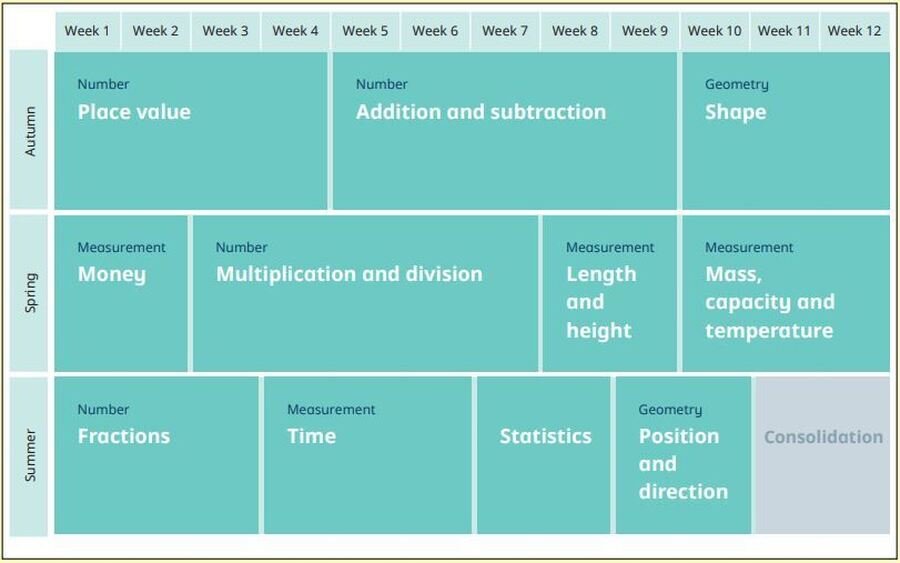
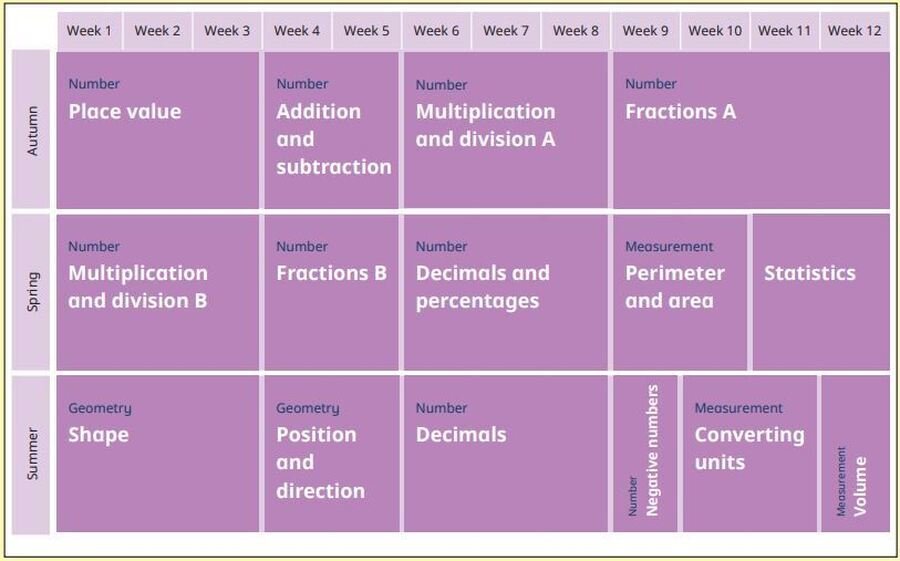
Year 2 long term overview 2026 - 2027
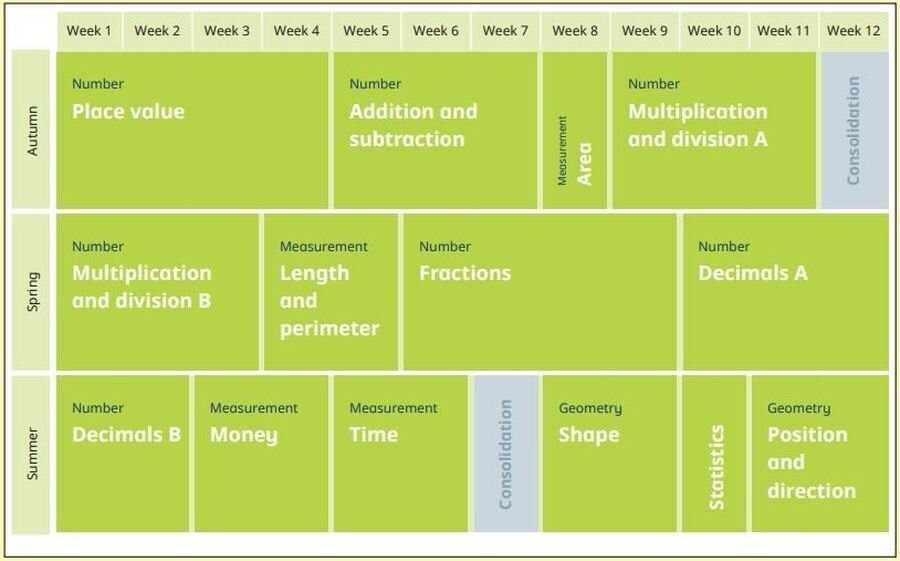
Year 4 long term overview 2026 - 2027
Year 6 long term overview 2026 - 2027

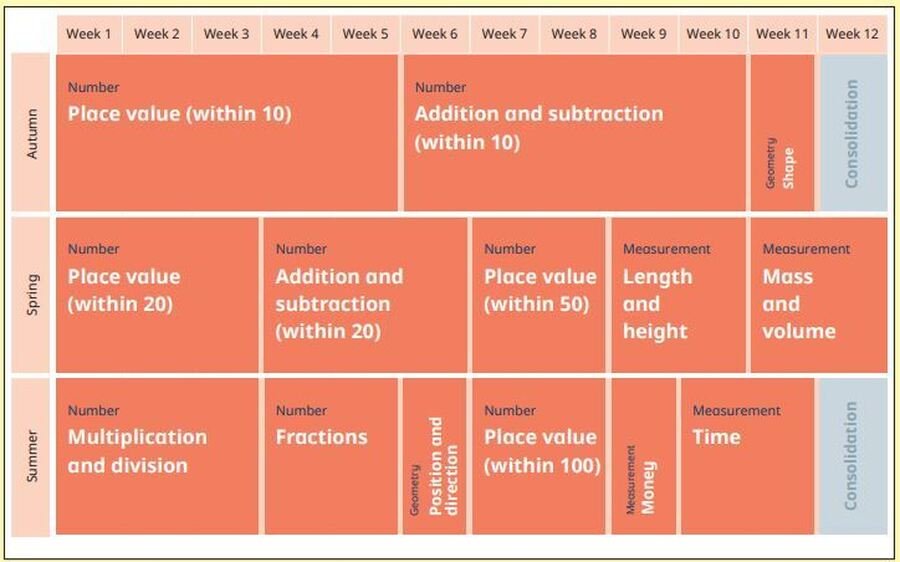
Year 1 long term overview 2026 - 2027
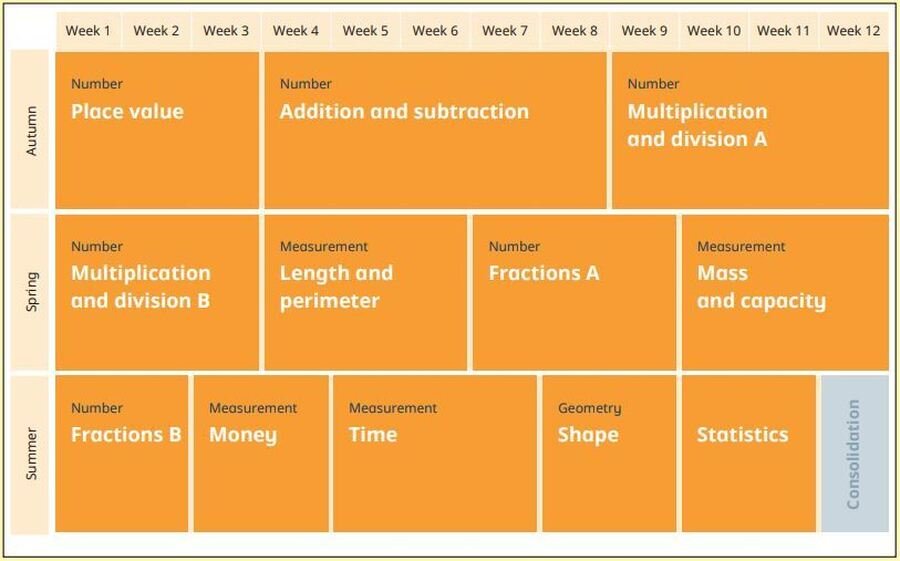
Year 3 long term overview 2026 - 2027
Year 5 long term overview 2026 - 2027
White Rose Maths
Throughout the school, children are taught using the White Rose Maths framework for teaching. White Rose provide small steps of learning where each step builds carefully from the previous step and builds on pupils’ prior knowledge to develop new skills, which supports our mastery approach.
Multiplication Tables Check (MTC)
By the time children reach the end of Year 4, they are expected to know all of their multiplication tables up to 12 x 12 at a good rate of recall.
At the end of the academic year, they will be taking a statutory multiplication tables check (MTC). The purpose of the check is to determine whether pupils can fluently recall their times tables up to 12, which is essential for future success in mathematics.
It will also help us to identify pupils who may need additional support.
For more information:
2026/27 Information for Parents: Multiplication Tables Check (click here)
Times Tables help:
Times Table Challenge
Times Table Challenge letter (click here)
We have a Times Table Challenge to help track children's progress in the learning of their multiplication and division facts up to 12 x 12, as is required by Year 4 in the new Primary National Curriculum.
This is an opportunity for children to learn the division facts which are the inverse of the times tables they have learned previously.
Traditionally, times tables were learned in order; 1 x 3 = 3, 2 x 3 = 6.
However, this is not useful for the real life application of those times tables or for completing written multiplication or division. Therefore, children will be tested in a random order of multiplication and division facts.
See your child's tracker in their school diary to see which multiplication they are working on.
Times Table Rock Stars (TTRS)
TTRS information for parents (click here)
We launched TTRS at Coppice Farm in Autumn 2019 as a way to help children with their recall of times tables. It has had great success so far with those who have used it regularly.
An example - we have had a child in Year 4 going from answering questions up to 12x12 in 18.18 seconds per question to 0.88 seconds per question. Amazing results!
By the time your child reaches the end of Year 4, the National Curriculum specifies that they should be able to recall the multiplication tables up to and including 12x12.
From June 2020, the children in Year 4 are required to take an online multiplication tables check where they will be asked 25 questions and be expected to answer each one in under 6 seconds.
For year groups 2 - 6, each child has a log in for TTRS and their teacher should have set their 'Garage' mode to the times table(s) they are working on.
If you have any issues with logging onto TTRS, please speak with your child's class teacher and they will be happy to help you.

What do our pupils say about Maths at Coppice Farm?
March 2024
Do you enjoy Maths?
EYFS - "Yes. It’s fun and we get to do active learning."
Y1 - "Yes because its work. I’m good at work."
Y3 - "I like that it has so many different topics – division/fractions etc"
Y4 - "I like it. I like that we do starter questions which get our brains going."
Y4 - "Yes because it teaches you more stuff than other lessons."
Y6 - "Kind of – I like how Miss Thurman does it – some bits are hard like percentages. I enjoy doing long division. "
Do you feel challenged in Maths lessons?
Y3 - "It’s not easy – you get your mind going."
Y4 - "Yes when we do questions." [referring to independent work]
Y6 - "Yes sometimes (asked which bits) During independent work/anchor task – it’s a good thing because it pushes me."
June 2023
How do you feel when you are about to start Maths?
Y2 - "Energised because I think I'm going to get all of the answers right!"
Y3 - " I feel happy because it's one of my favourite subjects. I like doing shapes."
Y4 - "I feel relaxed because it's enjoyable."
Y5 - "Quite excited - Maths is easy."
What can you do if you get stuck in Maths?
Y3 - "Read the question again. Think about it. If that doesn't work, ask a teacher."
Y4 - "Take a deep breath, read the question again and have another try."
Y4 - "Ask the teacher or a friend for help. We also have things in our class like hundred squares, times table bookmarks and cubes."
Every year at Parents' Evening, we get asked the key question:
"How can I help my child with maths at home?"
Which is then followed by the worry of telling their child the wrong way to work out an answer or even being told by the child themselves that it isn't how they did it at school that day.
Above in the 'useful documents' section, you will find our updated calculation policy which goes through the way we teach maths concepts in school.
2 key things to help your child on their way to being successful at maths is:
Telling them they are great at maths
Telling them that you like maths (even if in reality you don't!)
Many parents will say, "I hated maths when I was at school" .. or .. "I wasn't/I'm not very good at maths myself."
Try not to share these negative thoughts about your own experience with maths as these can then pass onto your child. Maths lessons have evolved over the years and is taught VERY differently, with many children in Primary really enjoying their lessons.
Point out the use of maths skills in everyday life where possible:
- Counting - playing board games
- Measurement - baking
- Money - paying for items at a shop, checking change, food shopping, saving/spending pocket money etc
- Time - telling the time on analogue and digital clocks, travelling
- Shapes - spotting shapes when out for a walk
- Fractions - cutting cakes, sharing toys, slices of pizza
I've also included a document below with some more invaluable tips from Professor Jo Boaler about advice for parents with maths at home
Click here for 'Advice for Parents from Professor Jo Boaler document'
Below is a list of maths APPs (mainly FREE ones) which can be used to help with your child's maths skills.